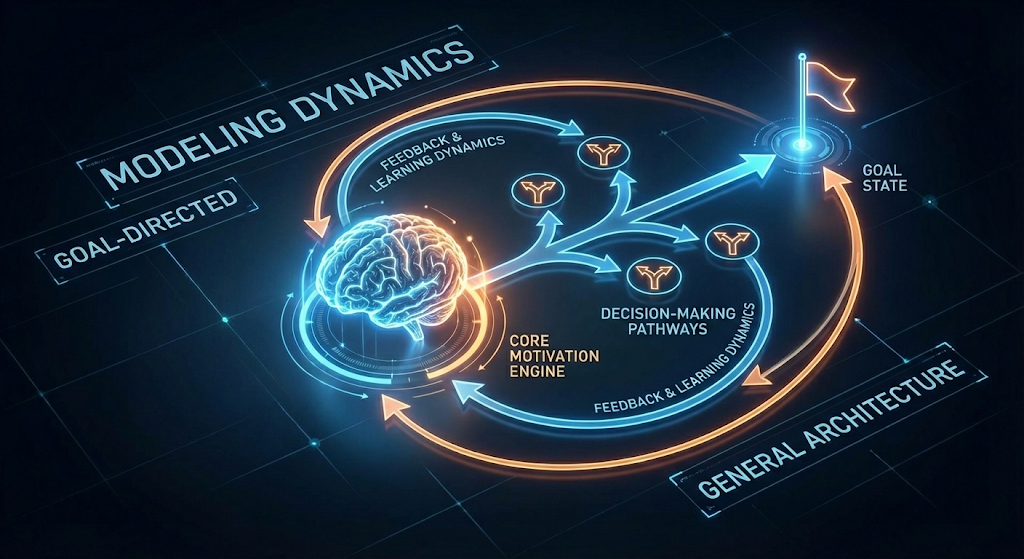
GOAL architecture is a formal psychological model of motivation dynamics that underpins Slarti’s design. In simple terms, it’s a framework that tracks and responds to key factors that affect your drive to pursue a goal. Instead of just setting a goal and deadline and hoping for the best, Slarti’s AI-powered planner continuously monitors:
- Your distance to the goal – how much progress you’ve made versus how much is left.
- Time to deadline – how far away the due date or target date is.
- Required progress rate – how quickly you need to work to reach the goal on time (tasks per week, study hours per month, etc.).
These three variables matter because they directly influence motivation. GOAL architecture isn’t just a catchy name – it reflects an evidence-based cycle of Goal setting, Ongoing feedback, Adaptive planning, and Looping adjustments. By formally modeling how motivation rises or falls with changes in goal distance, deadlines, and pace, Slarti can adapt in real time. It’s like having a smart coach in your pocket that understands why you might procrastinate and what will re-energize you, rather than a static goal tracker that only reminds you of what you haven’t done.
Distance to Goal: The Motivation Gradient
How far away your goal feels can make or break your motivation. Psychologists describe a goal gradient effect: our efforts tend to increase as we get closer to the finish line\[3\]\[4\]. In classic experiments, rats ran faster the nearer they got to a food reward, and modern studies found people buy coffee more frequently as their loyalty card nears a free reward\[5\]. In other words, motivation intensifies with proximity to a goal\[4\]. GOAL architecture takes advantage of this phenomenon.
- When a goal is far away, it doesn’t feel urgent or real, so it’s easy to procrastinate and “leave it for later.” In fact, when a goal’s completion is very distant, motivation to work on it tends to be low\[6\]. You might recognize this in semester-long projects or New Year’s resolutions – there’s plenty of time later, right? Unfortunately, “later” turns into last-minute panic or even abandoning the goal.
- When a goal is within sight, we naturally get a burst of energy and focus. Think of the final laps of a race or the last chapter of a thesis – as the distance to goal shrinks, you push harder to get it done.
Slarti monitors your distance to goal and uses it to keep you engaged. For long-term goals that might otherwise feel out of reach, Slarti creates nearer milestones and visual progress markers. By breaking a big goal into smaller chapters and sub-goals, showing you how far you’ve come, the app leverages the goal gradient effect to make even a distant finish line feel closer. For example, if you have 10 chapters to read, Slarti might celebrate when you finish chapter 5 (“Halfway there!”) to give a sense of progress. Tracking how close you are and acknowledging each step helps maintain momentum\[7\]\[8\]. Instead of letting a goal drift in the background until it’s urgent, GOAL architecture keeps the path visible and rewarding.
Motivation and Deadlines: The Power of Urgency
Deadlines often have a bad rap, but they can be powerful motivators. We’ve all noticed how a looming due date can suddenly ignite productivity. Psychologists have found that as people approach a deadline, they typically become more motivated and work harder on the task\[9\]. A deadline creates a sense of urgency – a healthy stress that says “it’s now or never,” which can boost focus and effort\[10\]. This is why students often produce their best (or at least fastest) work right before an exam or paper deadline.
GOAL model pays close attention to time to deadline. It knows that time is a critical ingredient in motivation. When a deadline is far off, the pressure is low and procrastination easily creeps in\[11\]. Slarti counters this by setting intermediate deadlines and reminders to simulate urgency in a balanced way. For instance, if your ultimate deadline is 6 months away, Slarti might establish monthly or weekly checkpoints. This keeps your brain from feeling too “safe” and delaying action indefinitely. Essentially, the app gives you just enough deadline pressure throughout the journey to spur action without overwhelming you.
On the flip side, if a deadline is imminently close and you’re behind, stress can spike. Slarti’s dynamic planner can detect this scenario as well – if you have a week left but a huge chunk of work remaining, the app might suggest adjusting the plan (e.g. prioritizing the most critical tasks) rather than simply flashing an overdue alert. It’s designed to provide deadline-driven feedback that motivates, not paralyzes. This ties into the Yerkes-Dodson law, which says performance improves with arousal (stress) only up to a point\[10\]. Slarti strives to keep you in that optimal zone: enough urgency to stay driven, but with guidance and reassurance so you don’t hit the burnout point. In practical terms, that could mean gentle nudges when you’re coasting, and calming encouragement (“Take a deep breath, you can still do this – let’s focus on the next small step”) when the deadline is near.
Required Progress Rate: Staying on the Right Pace
How fast you need to move right now to reach your goal by the deadline. If the goal is large and the time is short, your required pace is high; if you’ve done a lot already or have plenty of time, the required pace is lower. Why does this matter? Because humans are surprisingly sensitive to whether we’re “on track” or not, even if we don’t consciously calculate it.
Motivational science shows that we constantly gauge our rate of progress and adjust effort (or emotions) accordingly\[12\]. According to psychologists Carver and Scheier, we have an internal feedback loop for goal pursuit: if progress is slower than expected or needed, we feel worry or dissatisfaction (negative affect), which should push us to work harder; if progress is faster than needed, we feel satisfied or relieved (positive affect), which can lead us to ease off the gas\[13\]. In other words, falling behind can spur urgency, while being ahead might cause coasting. This has been demonstrated experimentally – for instance, when people got feedback that they were ahead of schedule on one task, they unconsciously reduced effort on it and shifted attention to other goals\[14\]\[15\].
Why is GOAL Architecture an important element of Slarti?
- A key element of GOAL's architecture is its consideration of the psychology of motivation. By tracking the distance to your goal, the time it takes, and the speed you need to achieve it, Slarti finds the right balance—providing urgency when you need a boost and respite when you're overwhelmed. It considers both the practical side (task rescheduling, goal recalculation) and the emotional side (support, encouragement, empathy). Most static planners focus solely on the practical side, leaving motivation up to you, so they often remain abandoned apps on users' phones. Slarti is different: it's proactive. It's designed with the premise that maintaining motivation is as important as the plan itself.
In other words, static apps answer the question, "What should you do?" but Slarti also answers the question, "How do you feel about this, and what do you need right now to keep going?" It's this human-centered, adaptive design that makes Slarti's GOAL architecture revolutionary for both procrastinators and highly productive people. Whether you're trying to stop procrastinating or simply want to optimize your productivity, a system that dynamically supports you can significantly improve your results.